settings
In Search of Lost Time [volume 1] vocabulary
423 vocabulary words, including people, places, music, artists, etc.


help & settings
[x]
-

Sarah Bernhardt
-
notes:
[theatre]
synonyms: Divine Sarah ???
tags: [actor]
► definition
Definition:a dramatic artiste, born in Paris; of Jewish descent, but baptized as a Christian; distinguished specially as a tragédienne; of abilities qualifying her to shine in other departments of the profession and of art, of which she has given proof; b. 1844.Rev. James Wood. The Nuttall Encyclopedia (1907)---a French stage actress who starred in some of the most popular French plays of the late 19th and early 20th century, including La Dame Aux Camelias by Alexandre Dumas, fils, Ruy Blas by Victor Hugo, Fédora and La Tosca by Victorien Sardou, and L'Aiglon by Edmond Rostand. She also played male roles, including Shakespeare's Hamlet. Edmond Rostand called her "the queen of the pose and the princess of the gesture" while Victor Hugo praised her "golden voice". She made several theatrical tours around the world, and was one of the first prominent actresses to make sound recordings and to act in motion pictures.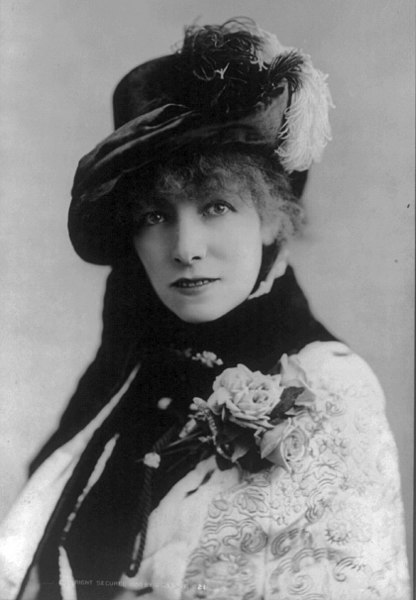 photo: By Napoleon Sarony (1880)sound clip: public doman, http://creativecommons.org/publicdomain/mark/1.0/
► uses
Uses:
Once the curtain is raised, the actor ceases to belong to himself. He belongs to his character, to his author, to his public. He must do the impossible to identify himself with the first, not to betray the second, and not to disappoint the third. And to this end the actor must forget his personality and throw aside his joys and sorrows. He must present the public with the reality of a being who for him is only a fiction. With his own eyes, he must shed the tears of the other. With his own voice, he must groan the anguish of the other. His own heart beats as if it would burst, for it is the other's heart that beats in his heart. And when he retires from a tragic or dramatic scene, if he has properly rendered his character, he must be panting and exhausted.
Sarah Bernhardt. The Art of the Theatre (1925)
---
When quiet was restored M. Delaunay suggested that the poet should be solicited for a new dramatic work. The enthusiasm was renewed at this suggestion, and it may well be imagined that the acclamations reached their culminating point when Sarah Bernhardt rose and embraced the aged author of Hernani.
G. Barnett Smith. Victor Hugo, His Life and Work (1885)
---
she still continued to regard him as brilliantly clever, when, after she had invited him to see and hear Sarah Bernhardt from a stage box, and had said politely: “It is very good of you to have come, Doctor, especially as I’m sure you must often have heard Sarah Bernhardt; and besides, I’m afraid we’re rather too near the stage,Marcel Proust. In Search of Lost Time [volume 1]
help with search